What the Top 1% Are Starting to Audit That Most People Still Ignore

In the last post I wrote about why we wait for a crisis before we look at the mind. About how previous generations survived on willpower and we inherited their silence as a template. About how the car gets serviced and the mind gets nothing until it breaks.

Today I invite you to read a story. The name is changed, but the archetype is many of us.

Meet Arjun.

I have met many Arjuns. Over coffee, in conferences, at dinner parties, in close family circles, and in my neurofeedback practice.

Arjun had built something real. Thirty-eight. Co-founder. 140 people on payroll, investors had bet on him twice and kept betting. He could read a boardroom in thirty seconds, who held the real power, where the resistance was, which objection was genuine and which was just posturing. He also had three drinks most evenings to come down from the day. Specific brand, specific number of ice cubes, specific chair. His body had learned to expect it by 9pm. Without it, sleep took two hours to arrive. With it, he woke slightly foggy. Seven, eight hours of sleep most nights but not quite rejuvenated. Nothing that a coffee could not fix. He did not think of this as a problem. He thought of it as daily drill.

You might recognise some version of this. Maybe not the drinks. Maybe it is the golf every Sunday, not because you love golf, but because two hours on the course is the only place the phone stays in the bag. Maybe it is the meditation retreat you book once a year, knowing the calm will last about eleven days before the city reassembles itself around you. Maybe it is Netflix after the kids are asleep, not because you want to watch anything in particular, but because the blue light and the noise fills the space where your own thoughts would otherwise be. Maybe it is two drinks at the club, the familiar faces, the easy conversation, enough to take the edge off without anyone asking what the edge actually is.

None of these are wrong. All of them are intelligent.

And all of them are the mind managing, rather than the mind actually recovering.

There is a difference.

Managing means getting through the day and the evening and the week without anything breaking. Recovering means actually returning to baseline, to a state where the nervous system is not quietly carrying the accumulated weight of everything that came before.

Most high-functioning people are exceptionally good at managing. They have built entire lives, careers, routines around it. The golf, the retreat, the drinks, the Netflix, these are the infrastructure of management.

What they have not built is recovery.

At a routine checkup Arjun’s doctor noted borderline blood sugar, slightly elevated liver enzymes, and blood pressure sitting at the higher end of normal.

Nothing dramatic.

Nothing that required immediate action. The kind of report that gets filed away with a note to watch it.

His doctor mentioned, almost as an afterthought, that chronic stress loads can drive all three. Arjun nodded. But the numbers in his head, quarterly growth, burn rate, market share, felt far more real than the vague concept of stress.

Said what most of us say in that moment. We all have that, doc. A little bit of stress is normal, right?

His doctor smiled. Did not disagree. Mentioned a colleague who did stress profiling. Gives you an accurate picture of how much stress the nervous system is actually holding. Worth looking at, he said, almost as an aside.

Arjun took the number, put it in his phone, fully intending to forget about it.

But the comment stayed with him on the drive home. Not because it alarmed him. More like an unskippable YouTube ad, appearing between thoughts, gone before he could fully address it, returning at the next gap. He had read something recently about heart attacks in men in their early forties. The numbers in India were going up. He remembered the statistic clearly because he had filed it under relevant but not urgent. The category where most things about his own health lived.

But I do not do anything bad, he thought. Not really. Last year he had gone to a mindfulness retreat. Three days, no phones, breathing exercises, the whole thing. He had come back genuinely lighter. He meditated most mornings, not long, ten minutes sometimes, less on bad days, but the intention was there. He had a gym membership he used. Not every day but enough. A whiskey occasionally was not a problem. One drink to help sleep on certain nights was not a habit, it was just practical. Everyone did something to come down. What more can a person do.

The drive was an hour. These drives had become, over the years, the time he took stock. No calls, no meetings, just the car and the city slowly thinning around him. He checked his phone at a red light. Two missed calls from his mother. None from his spouse. They had argued two days ago. Not a big thing, or so he had told himself. She had raised something, the same something she had been raising in different forms for months, and he had listened and explained and she had gone quiet in the particular way she had learned to go quiet. Not angry. Just absent. She had grown distant. He knew it. He kept meaning to address it properly, when things were slightly less busy, when he had more bandwidth, when the quarter closed. Will she leave? The thought arrived without warning, the way those thoughts do. Not as a question he was asking. As a question that was already there, waiting for a gap in the traffic.

He put the phone face down on the seat. He remembered a colleague who had gone to counselling last year. Someone had mentioned it in passing at a team offsite. He had nodded at the time, said nothing.

Is this when people go? Should he… He laughed even before the thought completed itself. Come on. What would talking change? He knew the patterns. He had read the books, understood the frameworks, could probably name what was happening in his marriage better than most therapists half his age with their fresh degrees and their worksheets. Self-awareness was not his problem. He had too much of it, if anything. And therapy. The talking kind. Sitting in a room explaining your childhood to a stranger. He had colleagues who had tried it, one had been going for three years and was still going. Still processing. Still arriving at insights that seemed to lead to more insights. Where did it end? Besides, he did not feel it was necessary. Private matters stayed private. He did not trust easily and anyhow in his experience nothing much came of it. Some things you handled yourself. That was just how it was.

His phone buzzed. A Slack notification. He looked. His thumb hovered over the number for a moment. Then he put the phone in his bag.

Somewhere on that drive he had started doing what he always did with a problem that would not resolve. Breaking it down. Work: on it. Health: managing better than most of his peers. Home: obviously. He was doing what was required of him. Shared the household load also sometimes. Then a bike rider cut him off without warning. He hit the brakes hard. Cursed out loud.

So, what is the missing piece?

I am not writing this to tell you to take therapy or not take therapy. And if therapy as a word is too loaded, call it something else. A coach. A mentor. A thinking partner. Someone trained to see what you cannot see from inside your own game.

I am saying this: keep your tools sharp. For most of us the primary tool of trade is the mind. Sharp not just for today, not just for this quarter, but optimised for the long run. We live in a time where gadgets track thousands of data points. Sleep cycles, heart rate, blood oxygen, step counts. Numbers are useful. But numbers alone do not create change. Better feedback loops do.

The avalanche does not announce itself. A wrong accident. A health number that is no longer borderline. A spouse who stops trying. A body that has been managed for so long it simply stops cooperating.

Kafka wrote a story about a man named Gregor Samsa who woke up one morning transformed into something unrecognisable. His family had depended entirely on his functioning. The moment he could not function, everything, the love, the warmth, the belonging he had assumed was solid, revealed itself to be far more fragile than he had known. We do not need a metamorphosis to get the message.

As for Arjun, he was feeling something he could not quite name. The fights drained him. Not emotionally, he had managed that. Practically. Three, four hours to get his head back to work afterwards. The mental residue of it sitting on everything. He could not afford to lose that kind of time consistently, not with the quarter he was having.

And there was something else.

A missing piece he kept reaching for and not finding. He knew he was stressed. Everyone was stressed. But how do they actually measure it? Is it another HRV tracker? Another sleep score? He was intrigued enough to find out. He called to discover.

Need met curiosity.

He went. He stayed because of what the map showed him.

That is a story for another post.

If something in this resonated, you know where to find me. shunyaneurofeedback.com

Chetna Punia

Counselling Psychologist, Biomedical Engineer, Neurofeedback Specialist

Auroville · Delhi · Remote

This is Part 2, If you missed Part 1, start here: The Mind Needs Maintenance Too

#HighPerformance #MindMaintenance #NervousSystem #Neurofeedback #ShunyaNeurofeedback

The Mind Needs Maintenance Too: Why We Wait Until Crisis Is the Wrong Strategy

“I don’t need therapy, I have my best friend.”

Your best friend loves you. That is exactly why they cannot help you with this.

“I don’t need therapy, I do breathwork and cold plunges.”

Your nervous system is grateful. The pattern underneath is still there.

“I don’t need therapy, I went to Vipassana.”

Ten days of silence can move mountains. The mountain sometimes moves back.

“I don’t need therapy, I journal every day.”

Journaling is powerful. Sometimes we just get better at narrating the same story.

These are not failures. They are the things we try before we understand what therapy actually is.

Your elders offer wisdom. Your relatives give perspective shaped by love and long history. All valuable. But therapy is structurally different from all of them. Confusing the two is one of the more expensive mistakes a person can make. Not just financially. In time, in stuck years, in decisions made from the wrong gear.

What I am sharing here comes from twelve years of professional practice and the living of a life alongside it.

When you begin as a therapist, counsellor or coach, you go by the book. Follow the protocol. Check your steps. This is not a limitation, it is the right and responsible thing to do. The protocol keeps the client safe and the practitioner grounded.

But something happens over time, if you stay curious and keep showing up. The book stops being something you consult and becomes something you have absorbed. The protocol becomes instinct. You stop doing the work and start being it. The framework is still there underneath everything but you are no longer reading from it. You are playing from it.

What I share here comes from that place. Not theory. Not gyan handed from a distance. Something lived through, in rooms with clients, in my own life, in twelve years of watching what actually shifts and what does not.

The Real Job

Life deals you a hand. You did not choose all of it.

Some cards arrived early and shaped how you see everything else. Some are fresh wounds. Some are old injuries that healed at the wrong angle, like a bone that joined incorrectly and became a permanent source of pain. Unchanged. Just the way things are now, it seems.

Therapy is coming to grips with the hand you have been dealt. Not denying it. Not being defeated by it. Understanding it clearly enough to play it as well as it can possibly be played.

Time does not stop while you figure this out. Life continues. The question is always: what is the best move from where I actually am?

Therapy brings you up to your own efficiency. It does not give you different cards. It helps you play the ones you have without the drag of unprocessed emotional charge pulling every decision sideways.

Why Willpower Is Not Enough

The brain is a stickler for routine, certainty and conclusions. When an experience is too overwhelming or too unresolved to process cleanly, it stores it in a way that keeps leaking into the present.

Trying to think your way out of this with willpower is like trying to see through a foggy windscreen by concentrating harder. The fog is the problem. Concentration is not the solution.

Decisions made from emotional dysregulation seldom lead to the right result. Seeing the bigger picture, even partially, even imperfectly, creates a strong enough anchor to swim toward.

That is the first job. Release the emotional charge. Bring rational, informed thinking back online.

The recipe differs for everyone. Talk therapy. Somatic work. Imagery. Brain-based approaches. Mindfulness. Meditation. Each reaches the same destination by a different route. Coming back to yourself with enough clarity to act from your actual intelligence rather than from your accumulated wounds.

It Is Not Because Something Is Wrong With You

There is a stigma around therapy that needs to be named directly.

Seeing a therapist does not mean you are broken. It does not mean you are mad. It does not mean you have failed at managing your life. These assumptions keep more people stuck than almost anything else. The quiet conviction that needing help is weakness, that the mentally strong handle things alone.

Think about how we see sports.

The best athletes in the world have coaches. Not because they cannot play. Because the coach sees what they cannot see from inside the game. Nobody looks at a world-class player working with a coach and thinks something must be wrong with them.

The mind is no different. A therapist is a coach for the inner game.

And the smarter approach is not to wait until something breaks. A car serviced properly and on time is far less likely to break down on the highway than one maintained only when something goes wrong. We know this about machines. We have not yet fully accepted it about minds.

The best time to plant a tree was twenty years ago. The next best time is now.

You do not have to be in crisis to benefit. You simply have to be a human being carrying the weight of a life, which is all of us, always.

Why Previous Generations Did Not Talk About This

Many of us grew up around people who did not go to therapy. Did not speak about mental health. Would have found the whole conversation unnecessary or indulgent.

They were not wrong for their time. They were right for their circumstances.

Previous generations dealt with survival in its most literal form. Wars. Famines. Poverty. The real possibility of death. When the house is on fire you do not decorate it. When the primary task is keeping yourself and your family alive, optimising the inner life is not the priority.

The mind has its own hierarchy. Safety first. Survival first. Maslow mapped this precisely. The mind does not come fully online until the lower levels are sufficiently met. You cannot process grief cleanly when you are hungry. You cannot do deep inner work when your physical safety is genuinely threatened.

This is not a failure of those generations. It is the logic of the nervous system doing exactly what it was designed to do.

It is true even now. In a war zone, in active poverty, in genuine physical danger, therapy is not the first call. Finding safety enough to stay alive is. But see the context. Needs evolve. Once survival is sorted the mind comes online and the next job begins.

Shell Shock to PTSD to Polyvagal Theory

Look at the history of trauma itself.

Soldiers returning from the First World War showed symptoms nobody had language for. Trembling, nightmares, inability to function, extreme startle responses, dissociation. The military called it shell shock. Many considered it cowardice. Some soldiers were court-martialled for it. The possibility that the mind could be genuinely wounded, not through weakness of character but through overwhelming experience, was not yet understood.

It took decades. Two World Wars. Vietnam. Enough safety, enough distance, enough researchers with enough freedom to sit with the question. By 1980 Post Traumatic Stress Disorder entered the diagnostic literature. The wound finally had a name.

But naming it was only the beginning.

Why does the body tremble years after the danger has passed? Why does a sound, a smell, a tone of voice activate a response that belongs to a moment long over? Why does understanding it fully sometimes not be enough to make it stop?

Stephen Porges answered this with Polyvagal Theory, developed through the 1990s and 2000s. The nervous system is not simply a toggle between fight-or-flight and rest. It has three distinct states, social engagement, mobilisation and shutdown, each governed by different branches of the vagus nerve, each responding not to our thoughts about safety but to the body’s own moment-by-moment reading of threat.

Trauma is not stored in the mind as a memory that understanding can correct. It is stored in the nervous system as a state the body keeps returning to. The body keeps the score, as Bessel van der Kolk put it.

This changed everything. The nervous system needs to experience safety, not be told about it. Feel it, physically, in the body, in the present moment. This is why somatic therapies, neurofeedback, breathwork and body-based approaches are not alternatives to serious treatment. For many people they are the most direct route to where talk alone cannot always reach.

Shell shock named the wound. PTSD validated it. Polyvagal theory explained the mechanism and opened the door to a new generation of work.

We are living in that generation. Standing on the ground built by everyone who came before and suffered without language, without diagnosis, without the science to treat them properly. We can use what it took so long to build.

The Privilege of Optimisation

If you are reading this, your immediate survival is most likely not under threat today.

That is not nothing.

Once survival is sorted the mind comes online. Not because it was not there before but because it finally has the resources to attend to things it had to postpone. Patterns that were adaptive under pressure. Wounds that could not be tended to in the moment. Conclusions reached under conditions that no longer apply.

Optimising the mind is not a sign something is wrong. It is the natural next step once the foundational levels are stable. Previous generations could not always afford this step. We can.

Do not let the old narrative stop you. That struggling in silence is strength. That seeking help is indulgence. That the mind should manage itself without assistance.

The Irony Every Practitioner Knows

Here is something every therapist understands and rarely says out loud.

We can help the world. We cannot always help our closest ones.

Part of this is resistance. Real, human resistance that does not disappear because the person offering help loves you. Sometimes it increases. The closer the relationship the more loaded the dynamic. The person does not see a therapist. They see a partner, a parent, a sibling, a child. Roles carry their own rules.

But there is another layer that is harder to admit.

When you have spent years reading patterns in other people, a particular bias quietly takes hold. You begin to feel that you know. You can see what needs to shift. And that certainty, however clinically founded, can itself become the obstacle. Not their resistance. Yours.

Relationships bring the best mirror. And sometimes when we look into that mirror honestly, the problem is us. Our own unresolved material showing up dressed as insight.

The Work Is Never Finished

This is why a practitioner who stopped doing their own inner work five years ago is working from an outdated operating system.

Tools need maintenance. Updating. Upgrading. Not because the foundation was wrong but because life keeps moving and we keep changing. What was true about ourselves at thirty-five is not the whole truth at forty-five.

Turning the mirror inward is not a one-time event. It is a discipline. The same discipline we ask of our clients we owe to ourselves. Continually. Not as a burden but as the price of staying genuinely present in a room with another human being.

There is no shortcut to repetition. The intelligence is in knowing what to repeat and what to drop.

The Only Thing I Want You to Take From This

Do not drive the aeroplane on the ground. It is built to fly.

The mind carrying unprocessed weight, old patterns, conclusions reached from a place of inefficiency, is an aeroplane taxiing indefinitely on the runway. Capable of extraordinary things. Not yet doing them.

Find your fit. Start where you are. The next step on the ladder is always the most important one.

Your mind is the instrument you use for everything. Every relationship, every decision, every ordinary day. It deserves at least the same investment you give your body.

Therapy, in whatever form fits you, is the clearance to take off.

If you are curious what your own nervous system might show on a brain map, I am available for a conversation.

Chetna Punia

Miles Away From Now

On the images that keep us from now, and the work of coming back

I was thinking about trauma while looking at the full moon last night, sitting on the grass. Often at moments of stillness like this, integrative thoughts come to you, telling about the life lived, lives witnessed, with all its spectrum of pain, pleasure, distress, motivation, ambition, falls and rises.
Trauma is a heavy word these days, quite loosely used. In my understanding so far, looking and working with many clients, reading about many more, and having lived some small experiences myself.


The Images That Won’t Let Go
These are the images in the head hardest to shake. They are so sticky that they end up colouring your entire life, what you do and what you absolutely don’t do, what you move towards or against, what you open up to or close to, what makes you vigilant or reckless.
These are like big red warning signs flashed inside the brain that refuse to stop unless we distract ourselves with people, substance, or other mind-numbing things, escaping into all sorts of revelries.
Often we get second-hand trauma when parents went through something and their experience becomes our narrative. A death of a sibling, divorce in the family, suicide in the circle. Images again, whether the ones we saw and experienced or the ones we created while listening to the stories.


Lived, Released, Not Memorialised
Bad memories need to be lived and then let go. Memorialising them does no good. Ever.
A thought that stayed at the back of my head for years, what would happen to memories if I got Alzheimer’s? They would simply go. Which means what I cling to so much is not really mine. I can lose it. And if that is true, then what is actually mine?
I came to my reactions, my ideas, my preferences, that makes me, me. But NLP training told me it is so easily changeable. So that foothold disappeared too.
I spent some years in that limbo. The question had no satisfying answer and I had stopped pretending it did.
Then out of nowhere, under another full moon, sharing with someone, the thought came. I don’t need a permanent mine. I might just want to nurture what is in front of me asking for my presence. The animal, the plant, the person.
I forgot to count myself in. I had lived that way for years, years of depletion, before I realised I wasn’t on my own list. That came from anxious avoidant attachment. From love is earned. I am still there but I am learning to count myself in.


Grime Behind the Images
Mind you, there is grime behind the images. The sticky pictures are only the surface. Behind them are older, quieter things, about worthiness, love, safety, that the visible images have been sitting on top of all along.
This is deep cleaning work. Continuous work. Like dusting the house, not because it is falling apart, but because you want to live in it well.


The Work, and What Comes Before It
Now it takes serious work, not long work always, but serious work, to shake the images that are a hurdle. To stop that flashing warning that is stuck and solves no purpose. To wipe out the noise when it is not in the present.
What the work does, though, is reduce the charge, the emotional voltage the image carries. It doesn’t vanish. It just stops collapsing time. It becomes past tense, filed where it belongs, no longer mistaken for now.
It takes work. Before work it takes acknowledgement. And before acknowledgement it takes willingness.


The Exception: Grief
It is trickier with death. Because the image in the head is the only connection we have left. If we let that go, we let go forever. We have nothing left. It is scary. And guilty too, how can I be happy in their leaving? I must be sad forever.
This is not weakness. This is love with nowhere to go.
The work with grief is not to stop loving. It is to let the charge of the pain soften while the warmth of who they were remains. The image does not have to hurt to be a connection. But that takes time, tenderness, and often real support.


We Are Attached to Our Misery
If we carry these images long enough, they are us. And although we may say we want to get rid of them, when we do we feel the unknown void. To get rid of them is also to be willing to feel the discomfort of not having them, that will be an unknown feeling. Short time discomfort but not pleasure by any means.
This is where the quotes like we are attached to our misery comes from. It is not a moral failing. It is just the way identity clings to what it knows.


The Images We Haven’t Lived Yet
There is a third kind of image. The future we have already planned. Man proposes, God disposes, and yet we keep proposing, running after a conclusion. These are fantasies but they also keep us stuck. Only if I do it. Only if I get there.
This is attachment. The brain fixated on a conclusion misses the correct decision contextually, it is too busy navigating towards the destination it already imagined to read what is actually in front of it.


This is where Krishna says don’t be attached to results, do your work. To do work diligently, presence is needed in the present, not miles ahead. It is not a counsel of passivity. It is a description of where good work actually comes from. What you are fated to receive will find you more easily when you are not miles ahead of yourself.
The past image freezes you in what was. The future image freezes you in what might be. Both are a form of not being here.


What Living in the Present Is Not
Being here is not recklessness. It is not throwing away the diary, ignoring consequences, living as though tomorrow does not exist. People hear be present and imagine someone drifting, unmoored, making no plans, learning nothing from experience.
That is not presence. That is dissociation with better branding.


Presence means the past informs without binding. You carry what you have learned, lightly, as reference not as sentence. Presence means the future orients without consuming. You have direction, you have intention, but you are not so far ahead of yourself that you miss what is here.


The present is not a rejection of time. It is where time is used well. It is the only place any actual decision, any actual connection, any actual work can happen. Everything else is rehearsal or memory.


Where It All Sits Together
Real freedom is the freedom from these images, past, future, all of it, because they freeze us in time. They don’t let the prefrontal cortex become alive fully.
A lot of people hear drop the ego and picture someone who never pushes back, never says no, sits in beatific calm while ill treatment is accorded. That is not it. That is a doormat with a spiritual vocabulary.
The ego is the accumulation. Every wound that was never processed. Every belief system absorbed from people who were themselves wounded. Every borrowed identity that fit well enough in a crisis and then never got returned. This builds up over years. It calcifies. It gets rigid.
Rigid is the key word. Because a healthy self is fluid, responsive, able to update. The ego is not. The ego has decided. It knows what the world is, what love means, what you deserve, what is safe. It decided a long time ago and it has been defending that decision ever since.
That is the creepy slimy thing about it. It mimics you. It speaks in your voice. It feels like your deepest truth. But it is mostly just old sediment that has never been questioned. And it will run your entire life if you let it.
The ego that needs dissolving is not your healthy self. It is not your boundaries, your discernment, your right to say this is not acceptable. It is not your ambition or your self-actualisation. None of that needs to go.
What needs to go is the identification with the images. The self that cannot exist without its story. The person who without the wound does not know who they are, what they stand for, where they end and the world begins.
When that ego drops, what is left is not emptiness. It is not a person with no ground. It is something steadier than what was there before. You know what you will and will not accept. You know what you value. You know where you stand. Not because the wound told you, but because you do.
That is your own axis. And from your own axis, real boundaries are possible. Real generosity is possible. Because you are giving from ground, not from fear of what happens if you don’t.
It is where chanting can give respite from again and again being pulled into the same narrative. It is where rituals and routines of religion can override the overthinking, over-cautiousness, depression, give the hope, a rope to hold on to. But one has to be sharp. Ritual without awareness becomes its own avoidance.


There are scientific things one can do too, EMDR being one, Brainswitch being another, Neurofeedback being one. All of them working on the same thing from different doors.


The Instrument
This is spiritual work, this is reparenting work, this is rewiring work, this is cleaning work, developing the instrument for better function.
To live fully is to be able to function with all senses in the present. Where knowledge of the past doesn’t bind but gently informs. Where hope of the future doesn’t consume but quietly motivates. And in between those two, here, there is room to manoeuvre, the agility and adaptability of choosing with free will what we are fated to encounter in life.


To Propagate, To Nurture, To Pass It Forward
Out of full living, not escaping, naturally comes a desire to propagate, to share, to belong, to nourish and nurture. To show children the life. To pass the wisdom forward. Often in nurturing the child we reparent ourselves. With awareness everything can be made a bit more beautiful and apt to the context of present time. But even here I pause. Maybe the desire to be a nurturer is still a desire. Still the ego, wearing softer clothes. Maybe that too needs to be dropped. Or maybe it dissolves on its own when you are truly present to the child in front of you, not the child you imagined. Just the child. As they are. The flame of intelligence in them asking to be seen and sparked. I know it will not be my default mode any time soon. Maybe that is okay. That is enough for now.

For those who want to go deeper into the science and practice behind what this article touches on:
On Trauma, Memory, and the Body
van der Kolk, B. (2014). The Body Keeps the Score: Brain, Mind, and Body in the Healing of Trauma. Viking Press. The foundational text on how traumatic memory is stored as sensory image and sensation rather than language, and why it can hijack the nervous system decades later.
On Neurofeedback and Developmental Trauma
Fisher, S.F. (2014). Neurofeedback in the Treatment of Developmental Trauma: Calming the Fear-Driven Brain. W.W. Norton. Sebern Fisher’s cornerstone work on how neurofeedback directly changes brainwave patterns to soothe a nervous system stuck in chronic fear.
On EMDR
Shapiro, F. (2018). Eye Movement Desensitization and Reprocessing (EMDR) Therapy: Basic Principles, Protocols, and Procedures (3rd ed.). Guilford Press. The authoritative guide by the originator of EMDR. Recommended by the American Psychiatric Association for PTSD treatment.


On Attachment
Bowlby, J. (1988). A Secure Base: Parent-Child Attachment and Healthy Human Development. Basic Books. Bowlby’s foundational work on how early attachment shapes our internal working model of love, safety, and self.
Ainsworth, M.D.S., Blehar, M.C., Waters, E., & Wall, S. (1978). Patterns of Attachment: A Psychological Study of the Strange Situation. Lawrence Erlbaum. The research that identified anxious-avoidant attachment and mapped how it shows up in behaviour and relationships.
On Goal Fixation and Cognitive Narrowing
Kahneman, D. (2011). Thinking, Fast and Slow. Farrar, Straus and Giroux. Kahneman’s exploration of how the mind narrows around anticipated outcomes, including the planning fallacy and the focusing illusion.
On the Neuroscience of Fear and Prefrontal Suppression
Kredlow, M.A. et al. (2022). Prefrontal cortex, amygdala, and threat processing. Research documenting how trauma suppresses prefrontal function while the amygdala becomes hyperactive, the neurological basis of being stuck in threat-response.
For more on neurofeedback, reparenting, and the tools discussed in this article, visit http://www.shunyaneurofeedback.com

Understanding Neurofeedback for Enhanced Performance

I am sure you have realized that the best ideas come suddenly, as if out of nowhere. Those “Eureka” moments!

At least for me, I don’t reach insights by thinking hard. I think and plan once the insight has landed. Of course, we need to lay the roadmap and do the finer tuning to make it work, but the “Big Picture” idea? Its source is different. It is a creative spark.

As Iain McGilchrist beautifully describes in The Master and His Emissary, the right hemisphere of the brain is the true Master: open, holistic, and attuned to context, novelty, and the living whole. It sees the big picture and delivers those sudden creative insights. The left hemisphere, the Emissary, is excellent at detail, analysis, planning, and execution, but it was never meant to lead. In our modern world, the Emissary has become dominant, and we over-rely on its narrow, focused attention. This is why the deepest insights rarely arrive through forceful left-hemisphere grinding.

It doesn’t usually come when we are tired. Sometimes, yes, being pushed against the wall makes us creative from a survival point of view… but that isn’t sustainable, is it? How long can we run on empty fuel? We cannot sustain burnout.

In our youth, we might get away with it, but how we live today is the “karma” of how we grow old. The body holds onto it. The question is not only how well we do now, but also for how long we can continue to do well.

The Instrument and the Maintenance

The body is the vessel; the brain is the precision instrument.

Like any high-performance asset, they require maintenance, repair, and genuine care. There are different ways to tend to this system, and all are non-negotiable:

A good diet is your fuel; Good sleep is the plumbing and restoration. You can’t leave a computer on all the time; it needs to shut down. Movement is the oiling and lubrication, ensuring the joints and muscles stay active.

As the saying goes: what we don’t use, we lose.

The “Internal” Refresh Button

When it comes to staying creative, resilient, and keeping the brain healthy, we can do things from the outside: less screen time, less “brain-rotting” doom scrolling, and more active learning. But we have options on the inside, too.

Have you ever wondered if the brain had a restart or refresh button? Be honest: how many times have you tried the “switch it off and on again” method with a gadget that wasn’t working, and voila, it works!

What if you had that for your brain? A quick reset. A shower on the inside. A regulation of the brain at the neuronal level that helps alleviate brain fog, sluggishness, and the rumination that won’t stop, that looping of thoughts that keeps you from falling asleep without an extra drink or a smoke.

Precision Peak Performance

I am talking about Neurofeedback.

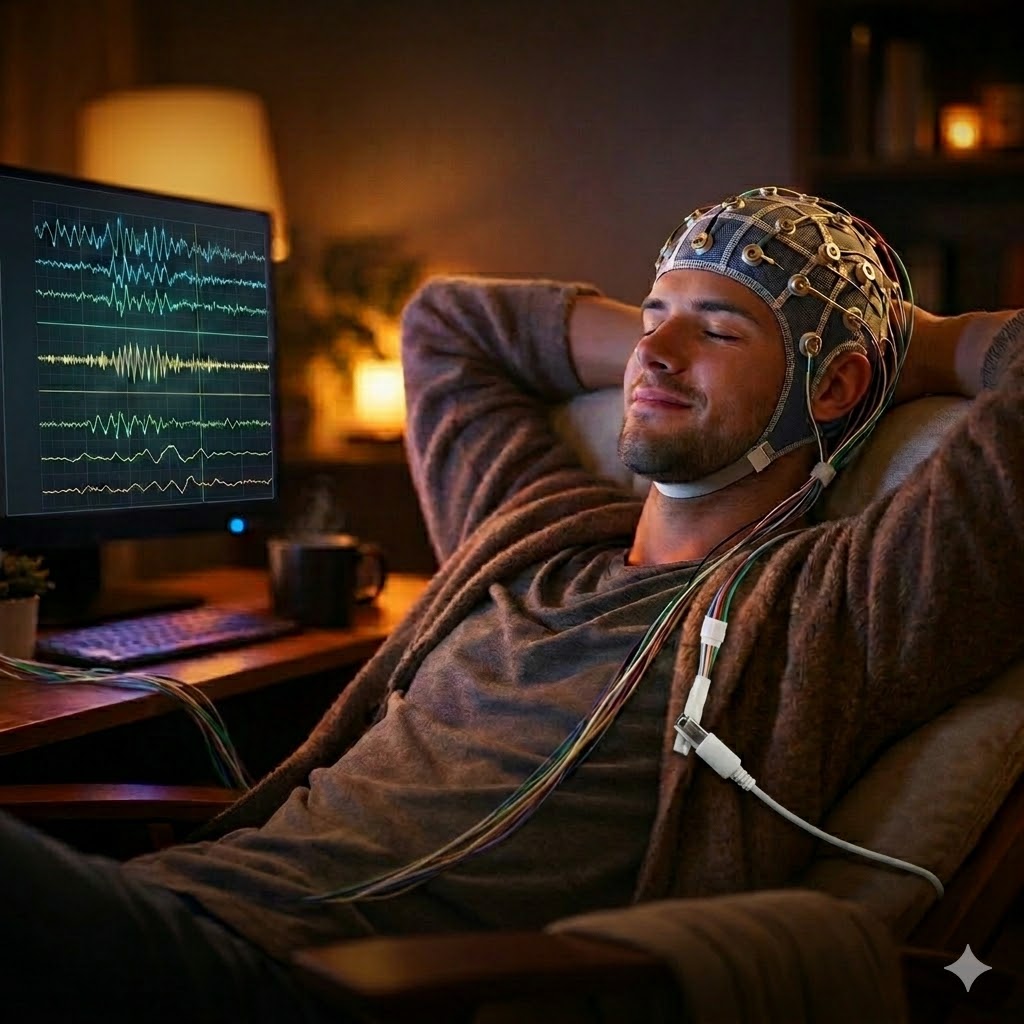
It does exactly that, and it is grounded in real brain science. Using qEEG (high-tech brain mapping), we take a “peek-a-boo” inside the head. This shows us which areas are talking to each other and which are at a “cold war.” We see which areas are shouting and why you are feeling what you’re feeling.

For example:

Too much high beta activity often fuels constant rumination and anxiety; the brain is stuck in overdrive.

Excessive low-frequency waves (theta/delta) are commonly linked to brain fog, mental sluggishness, and difficulty focusing.

Alpha asymmetry (especially in the frontal areas) can reflect mood instability or difficulty shifting out of negative states.

Frontal area dysregulation can reduce mental flexibility and impair clear decision-making, leaving you stuck in rigid thinking, second-guessing, or difficulty shifting strategies when the situation changes.

Temporal area dysregulation can destabilize temperament and emotional control. Small triggers can produce outsized reactions, making it harder to stay composed in high-stakes conversations or negotiations, sometimes resulting in costly errors in leadership, relationships, or critical business decisions.

An overactive Default Mode Network (DMN) keeps the mind wandering and looping on worries or self-doubt, stealing creative energy.

An over-reactive amygdala amplifies stress and emotional reactivity, making it hard to stay calm under pressure.

The insula (which helps us sense internal body signals) can become dysregulated, leading to poor emotional awareness or feeling disconnected from oneself.

Neurofeedback helps restore balance. The brain learns to self-regulate through real-time feedback, improving communication, calming overactive areas, and strengthening underactive ones.

This leads to better brain health: more stable focus, easier access to creative flow and Eureka moments, reduced mental fatigue, deeper restorative sleep, and greater emotional resilience.

That is the power of Neurofeedback.

Who understands the need for it more than entrepreneurs, CEOs, and those in the corporate rush? If anyone is closer to the changing dynamics and uncertainties of the world, it is you.

Many of the leaders I work with report clearer thinking, reliable creative insights, restorative sleep, better stress recovery, immensely better emotional regulation, and the ability to sustain high performance without burnout.

Your future performance and well-being depend on how well you maintain this instrument today.

Let’s talk.

Write to shunyaneurofeedback@gmail.com or WhatsApp 8270176656 to ask any further questions or to see how this can benefit you.

Gentle Neurofeedback Solutions for Autism Management

Why Neurofeedback is a Gentle Ally for Children on the Autism Spectrum

If your child is on the Autism Spectrum (ASD), you live through a unique set of daily mountains. You know the “sensory storms,” the sudden meltdowns that seem to come from nowhere, the struggle to find words, the sensory overload where the world just feels too loud, and the restless nights spent wishing for peaceful sleep. You are looking for a way to help your child feel more comfortable in their own skin. You want something safe, evidence-based, and gentle.

Many parents come to us searching for a “cure”, a way to take away the daily struggles their child faces. While neurofeedback is an evidence-based training rather than a “cure” for Autism, it fulfills the deepest wish behind that search: it serves as a gentle ally in helping your child navigate a world that often feels too loud, too bright, and too fast.

Many parents ask: “If neurofeedback isn’t a ‘cure’ for Autism, what exactly is it doing?” The best way to understand it is through a simple analogy: You cannot decorate a house while it is on fire. When a child’s brain is in constant turmoil, overwhelmed by sensory input, stuck in “fight or flight,” or clouded by excessive slow-wave activity, the brain is in “survival mode.”

In this state, it is nearly impossible to learn complex new skills like social nuances, advanced speech, or emotional empathy. The “fire” of dysregulation consumes all the brain’s resources. Neurofeedback is the tool we use to put out the fire.

This is where Neurofeedback offers a different path. It isn’t a medication or a forced behavior drill. Instead, it is a form of “brain training” that empowers your child’s brain to find its own balance.

What exactly is Neurofeedback?

Think of your child’s brain like a radio. Sometimes, the dial gets stuck on a station filled with static, too many slow, “foggy” waves, and not enough of the clear signal needed for focus and calm.

During a session at Shunya, we use non-invasive sensors to listen to these brainwave patterns in real-time. We don’t put anything into the brain. Instead, we show the brain what it’s doing through a simple game or animation. When the brain moves toward a calmer, more organized state, the “game” rewards them with a sound or a visual change.

The brain is incredibly adaptive. It thinks, “I like that reward!” and naturally begins to repeat those healthy patterns. Over time, these patterns become the brain’s new “default setting” even when the sensors are off.

Addressing the “Slow Wave” Challenge in ASD

Many children with ASD struggle because of an overabundance of slow brain waves (known as Delta and Theta) during the day. While these waves are vital for deep sleep, having too many of them while awake can feel like trying to run through water. It often results in:

  • Brain Fog: Difficulty staying present or following instructions.
  • Emotional Volatility: Sudden outbursts of anger or disconnected laughter.
  • Communication Gaps: Difficulty processing social cues or finding words.
  • Sensory Overload: A heightened “fight or flight” response to sounds or touch.

By gently guiding the brain to reduce these excessive slow waves, we help clear the fog. The result isn’t a “different” child, it’s your child, but calmer, clearer, and more regulated.

Real-World Progress: From Data to Daily Life

At Shunya Neurofeedback, we track progress through both sophisticated QEEG mapping and, more importantly, the changes parents report at home. When the Delta and Theta waves begin to balance, we often see:

  • Expanded Presence: A child who could only sit for 5 minutes might begin to engage and enjoy the session for 25 minutes.
  • Emotional Resilience: Big “meltdowns” or aggressive episodes often diminish or disappear entirely as the child gains internal control.
  • Emerging Language: Parents often notice new words appearing and, more importantly, being used to express genuine needs and feelings.
  • Restful Rhythms: As daytime waves stabilize, nighttime sleep often becomes deeper and more restorative.

A Snapshot of Change: In our practice, we’ve seen children move from highly dysregulated Delta levels down to a healthy, functional range within just a few months. This isn’t just a number on a screen; it translates to fewer outbursts, more smiles, and a child who feels in control of their world.

A Sustainable Journey

Neurofeedback isn’t magic, and it isn’t overnight. It is a process of learning much like learning to ride a bike. Because we are training the brain to regulate itself, the improvements are often long-lasting.

It works beautifully alongside speech therapy, occupational therapy, and your existing support systems. It simply provides the neurological foundation that allows those other therapies to “click” more effectively.

The Bottom Line

At Shunya, we believe in “slow wisdom”, the idea that sustainable change comes from gentle, consistent integration. Neurofeedback is a hopeful, non-invasive tool that helps your child move from a state of being “stuck” to a state of being connected.

Making Training Fit Your Life

We understand that for many families, geography and busy schedules can be a challenge. At Shunya, we believe the journey to regulation should be as stress-free as possible.

That is why we offer Remote Sessions, allowing your child to train in the comfort of your own home at a time that works best for your family.

  • The Process: We begin with an initial in-person consultation to map the brain and set the foundation. QEEG assessment in person.
  • The Convenience: Once the initial assessment is complete, you have the option to conduct the rest of the sessions remotely.

This hybrid approach ensures you get the clinical expertise of a professional consultation with the ease of home-based training. If geography is a problem, this option ensures your child doesn’t have to miss out on the support they need

You are already doing the most important work by being their advocate. Let us help your child’s brain do the rest.

Ready to start the journey?

Whether you are ready to book a consultation or simply have a few questions, we are here to help.

Connect with us today:

Letting Go of Emotional Burdens Through Neurofeedback

Neurofeedback and the Gentle Art of Letting Stories Lose Their Grip

Healing isn’t always about finding a better story; sometimes, it’s simply about giving the brain permission to drop the weight of a negative bias it has been carrying for years. When you carry this long-term bias, your brain isn’t being “pessimistic”; it is being protective. It has categorized “change” or “expectation” as a high-stakes risk.

Because of this, your system interprets reaching out, or even being reached out to, as a vulnerability. It creates a glitch in your radar where even when someone is being genuinely kind or showing normal, healthy emotions, your brain flags it as danger. Instead of feeling warmth, you feel a tightening, a suspicion, or a need to withdraw. Your nervous system triggers a stress response to pull you back into the safety of the “known,” even if that known is a familiar, isolated pain.

This habit eventually pushes away the very peace and people you crave, as your brain remains a professional “threat-hunter” even in the presence of love. Neurofeedback wordlessly resets that radar. It gives your body the physiological safety it needs to stop mistaking kindness for a threat, allowing you to finally put down the shield and start noticing the good.

“Think of M, who felt like he was constantly walking on eggshells. If his wife looked slightly tired, his brain told him it was a catastrophe he had to fix; if she cried, he went completely numb because he couldn’t process the ‘noise.’ After several sessions, he realized his wife’s emotions hadn’t changed, but his capacity to hold them had. He could finally see her frustration without feeling attacked, and her sadness without needing to run away. The ‘story’ of the marriage was the same, but his body had stopped reacting to her heart as if it were a threat to his own.”

Neurofeedback offers a unique kind of support in this tender space because it works beneath the stories. It gently trains the brain to reduce the hyper-vigilance and emotional flooding that keeps the “hope-crash” loop alive. As regulation improves, something surprising happens: the same thoughts and hopes may still arise, but they lose their overwhelming emotional charge. They pass more like clouds in the sky, noticeable, yet no longer controlling the weather of your entire day.

“Neurofeedback is like a mirror for your brain. By showing your nervous system its own real-time activity through sensors, it learns to find its way back to a calm ‘home base’ moving away from the ‘stuck’ patterns of high-stress or low-mood waves.”

You don’t have to force yourself to stop hoping or stop loving. You simply give your brain the conditions it needs to regulate. When the nervous system feels safer, the grip of the old patterns naturally softens. Clarity emerges. Choices become easier. Peace becomes more possible whether the outer situation changes or not.

“There is a specific kind of grief in realizing you’ve been holding your breath for years. Regulation isn’t about becoming indifferent; it’s about finally being able to exhale.”

If you’re tired of the loops and ready to give your nervous system the rest it deserves, let’s explore how neurofeedback can support your unique brain patterns. You don’t have to carry the story alone.

Get in touch to begin your journey: WhatsApp: +91 82701 76656 or

Email: shunyaneurofeedback@gmail.com

Finding Relief from Emotional and Mental Exhaustion

The Silent Exhaustion No One Sees

Read through to understand how Neurofeedback can help you when you’re just “getting by.”

You wake up, function through the day, do your work, exercise, journal, and still feel like you’re just getting by. The anxiety in your body may have lessened, but the quiet sadness remains. Thoughts loop in the background. You sit looking out the window, watching the sky and trees, wishing for rest that goes deeper than sleep.

This kind of exhaustion is often invisible. You look productive on the outside, yet inside, you feel drained, emotionally muted, and stuck in patterns you can’t seem to break even when you try so hard.

Neurofeedback is especially helpful for this state. It doesn’t ask you to dig into the “why” or relive the hurt. It simply helps your brain shift out of the chronic slow-wave dominance and low alpha buffering that keeps you in an “internally busy” mode.

As your brain learns to regulate, many people notice that the mental clouds pass with less pull. Moments of genuine lightness return in your regular day, the same lightness you felt after movement or a good neurofeedback session.

The nervous system finally gets the safety it has been craving, even if the outer situation hasn’t fully changed yet.

You don’t have to share the full story of your work, your marriage, your family, or your pain. You only need to show up and let your brain do what it naturally wants to do to find balance again.

Healing can be quiet. It can be wordless. And it can still be profoundly effective

Healing Without Words: The Power of Neurofeedback

You Don’t Have to Speak, Your Brain Can Still Heal

Some pain lives so deep that even saying it out loud feels exhausting. You’ve replayed the same loops in your mind for months or years, the arguments, the silence, the hope that crashes, the feeling of being unseen or put down. You know the story so well, yet telling it again to someone else feels heavy.

Here’s the gentle truth: You don’t have to share your story to begin healing.

Neurofeedback works directly with your brain’s electrical patterns. It doesn’t require you to explain what happened, who hurt you, or why you feel stuck. Instead, it gently trains your brain to move out of the chronic “internally busy” state, the one that keeps anxiety fluttering in your chest, thoughts spiralling, and rest feeling impossible.

When the brain learns to regulate itself, something beautiful happens: The stories that once felt all-consuming start to lose their traction. The emotional charge softens. The same thoughts may still pass through your mind like clouds, but they no longer pull you under with the same force.

Many people come to neurofeedback sessions saying almost nothing about their lives. They simply sit, let the gentle training happen, and slowly notice they can sit by the window, look at the sky, and feel a little more at ease, even while the sadness is still there.

If you’re tired or sceptical of telling your story, neurofeedback offers a different path: Quiet regulation. Gentle rewiring. Healing without having to explain.

You deserve relief, even if words feel too heavy right now.

Experience the relief of quiet regulation. Book your first neurofeedback session today and discover how it feels to heal without having to say a word.

Book Now

Email: shunyaneurofeedback@gmail.com WhatsApp: 8270176656

The Impact of Playful Learning on Child Development

Play to Learn; Learn to Play

Children learn gradually and in tune with their body capacities as they grow. For them learning is fun and they are as naturally doing it as breathing. Children learn by observing and modeling, children learn emotionally, physically, cognitively and children learn through various experiences and sort out world information in their own inner representations that are continually evolving into finer and finer neural circuits. Their understanding will always amaze an open minded teacher, they may grasp a meaning which was never discussed before and may not be the expected answer to the closed mind trainer. This distinction of what we expect out of children makes whole difference.

A teacher may have asked a kid to tell about an apple.

Expected answer- it is a fruit, it is red/green in color. It is sweet in taste.

Surprise Answer- I love banana.

Now in a conventional system a child would flunk his test, be reprimanded for not paying attention and would be ordered to study harder. This crushed his knowing , love for a banana and confident answering then and there. Whereas a holistic system accepts that child knows something, will appreciate his knowing that may be little different from expected answer but the teacher would assume, may be child does not like apple, or has never tasted it yet, even more it may be called  by some different vernacular name. The teacher would respect a kids answer and may ask further what you love about banana, when did you have it last, which other fruit do you like to have and so on with possibility of maneuvering his learning to expected answer and expanding his knowledge base. 

Conventional school system are biased towards abstract-symbolic modality. School lay emphasis on learning methodology, facts, figures with prime focus on “right” answer. Further, such demands are made in a highly competitive environment and at a age (3-8 year old) not neurologically mature. A child is given tasks that he is incapable to do yet neurologically, physically, emotionally and cognitively. Reading print in book, looking up and down to notebook from board which demand high foveal vision, hand-eye coordination when eyes are yet prepared only for field vision and unable to focus on page. Hearing consonants, words, commands when child is more able to learn emotionally charged rhymes, invent stories and play characters.

Forcing him to the same stresses and exhausts his system impeding natural learning pace. This is where learning problems first begin to start and show in form of reading, writing, comprehending, retaining or in form of learned failure, cranky mood, hyperactivity or physically manifested stress as weak eyesight, low stamina, ear infections, pain and/ or some form of disease. A child will associate any learning with a “task” and stress which will further lower his self-esteem and joyful living. At an age meant to climb trees, roll down hill mounds, catch butterflies, jump and race, rhyme and dance we order kids to shut up and sit quietly in a non stimulating classrooms to listen, hear, remember and reproduce lessons without a mistake. If unable to do so he is often labeled as slow learner, hyperactive, inattentive and child “learns” that he is worthless.

Academic learning is a specific system developed on line of industrial revolution and is concerned only with efficient output with left brain oriented tasks- reading , writing, remembering the facts, figures and concepts! All this without much emphasis to experiential learning. Learning is a disembodied mental exercise in schools. Academics behave as if body is a mere vehicle to transport brain (assumed to be only important and located in scalp) from one place to another.  There, kids are fed in info via visual and auditory channels, without permission to move, to talk and tested only on how efficiently they can reproduce in same mediums. There is biased emphasis on memorization and regurgitation rather than knowing and understanding.

It is drastically different from learning per say which we are all naturally tuned for , to make best out of this life.

Body/mind is stressed when it is asked to perform beyond its capacities. Each child is as able as his body/mind developed. A toddler cannot be expected to run because he is not able yet so does a 4-5 year old is not capacitated yet to reconstruct a lesson perfectly verbally and written without forgetting a word.  Such unreasonable demands would stress a kid- physically, emotionally and cognitively!

Stresses form in fields of reading, writing, learning and comprehending (cognitive stress as result of physical stress). Reading print (demands foveal vision) when eyes are only prepared for field vision and not able to focus on page (close distance) yet. Hearing consonants, words, emotionally devoid commands when a child is more able to learn emotionally charged rhymes, invent stories and play characters. Further, such demands are made in a highly competitive environment and at a age not neurologically mature. Till 6-7 years old a child is still exploring his body, extending its capabilities each day and ideal for him would be to play in mud, climb trees, sing songs, melodies, learn to emote and respond and what schools ask is a complete conflict.

It further takes toll on self esteem (emotional stress) and becomes associated with struggle, effort and frustration (attitudinal stress).  Consequently a child becomes physically tensed, emotionally withered and brain shut off with blocked attitude. Anything associated to “learning” becomes a task far from fun exploration and adventure. Motivation suffers, self-worth suffers and downward spiral ensues.

These problems can be balanced by opting a holistic system of school that teach in synchronization with child’s development. There are scattered examples of such schools like Danish school system and Krishnamurthi Foundation Schools to name few. In ancient Gurukul System of India (a child was sent to formally study only after 8 years of age, until then his play and interaction with world was his source of learning).

In a conventional school many problems would be rectified if all learning modalities are respected and flourished, a child is judged on his own growth scale rather than negative competition, and child is given opportunities to expand his strengths, capabilities and more focus on process rather than results.

It is in the process that mysteries of learning unfold, individual to each.

Understanding Migraine: Myths vs. Facts

Empower Yourself: Understanding the Journey to Being Migraine-Free

If you suffer from migraine, you know the agony like no other. If you are tired of trying everything under the sun without success, acknowledging that painkillers no longer work, and feeling that medications are taking a toll on your quality of life, read on.

Knowledge is the greatest tool to overcome obstacles. By understanding what a migraine truly is (and what it is not), you can empower yourself to take charge of your mind, body, and brain.

What Migraine is NOT (Debunking the Myths)

Commonly, migraineurs are told misleading or pessimistic statements. Let’s clear the confusion:

  1. It is NOT “Just a Headache”: Calling it a specific type of headache is misleading. This focuses only on the symptom, not the underlying condition.
  2. It is NOT a “Vascular Disease”: While popular for years, research now shows migraine is not caused by the swelling of blood vessels (vasodilation). Studies show attacks can occur without any changes in artery diameter.
  3. It is NOT “Incurable”: To say it is incurable is audacious. Countless people find relief through yoga, behavior therapy, or neurotherapy. Change begins with a shift in mindset.
  4. It is NOT strictly Genetic: While heritability is about 45%, the majority of people with “migraine genes” never suffer from them. We don’t just inherit genes; we inherit maladaptive thinking patterns, anxiousness, and stress. This is “nurture” influencing “nature.”
Migraine: A Disorder, Not a Disease

A disease usually implies an infection (viral/bacterial) or malignant cell growth. Migraine doesn’t fit this.

It is better classified as a disorder, a condition where the human machinery (the interaction between mind, body, and brain) is not in proper working order. Because it is a disorder of the system, it requires more than just over-the-counter painkillers; it requires probing the underlying issues of the whole person.

How the Brain “Misfires” During Migraine

Advanced imaging (fMRI, PET scans) shows us that a migraine is like an “electrical nerve storm.” Here is how different parts of your brain are involved:

1. The Brainstem (The Survival Center)

The brainstem handles instincts: hunger, sleep, breathing, and various reflexes. In migraineurs, this area becomes hyperactive—often called the “migraine generator.”

  • Symptoms: Nausea, vomiting, dizziness, light sensitivity, and stiff neck.
2. The Limbic System (The Emotion Center)

This includes the amygdala, your brain’s fear sensor. Migraineurs often have an overactive amygdala, leading to anxiety and worry.

  • The Trap: Being told to “avoid triggers” can actually make the amygdala more active by reinforcing fear and avoidance, which can make the pain chronic.
The Prefrontal Cortex (The Control Center)

This is the most sophisticated part of the brain, responsible for reasoning and keeping instincts in check.

  • The Imbalance: Migraine can be seen as an imbalance between inhibitory control (Prefrontal Cortex) and neuronal excitability. When the Prefrontal Cortex is weakened by stress or trauma, it can no longer “quiet” the nerve storms in the brainstem.
Your Odyssey to Being Migraine-Free

To overcome migraines, you must address the mind, body, and brain holistically by proceeding with logic and reason rather than just seeking another temporary cure.

1. Addressing the body requires moving toward a natural diet of fresh foods and assessing biochemical requirements like mineral deficiencies or hormonal imbalances.

2. Simultaneously, you must address the mind by slowing down to manage stress through abdominal breathing and yoga, while utilizing psychotherapy or CBT to introspect and clear out “malignant schemas” or emotional trauma.

3. Finally, you must address the brain through applied neuroscience, using neurotherapy such as QEEG-guided or LORETA Z-Score neurofeedback, to improve the stability of the central nervous system and retrain the brain’s electrical activity.

http://www.themigrainerevolution.com/what-is-a-migraine-3/

Take Charge of Your Journey

Do not just look for another doctor to prescribe more medicine. Find a therapist or a team experienced in rehabilitating migraines by addressing the mind, body, and brain together.

Knowledge + Logic + Commitment = Success. Your journey to a joyful, migraine-free life starts with taking charge today.

At Shunya Neurofeedback, we have helped many people regain their quality of life and move toward being joyfully migraine-free through our holistic, evidence-based approach.

Don’t wait for another attack to take charge of your health. Connect with Shunya Neurofeedback to book your session now.

Call us at: +91 8270176656

Email: shunyaneurofeedback@gmail.com